



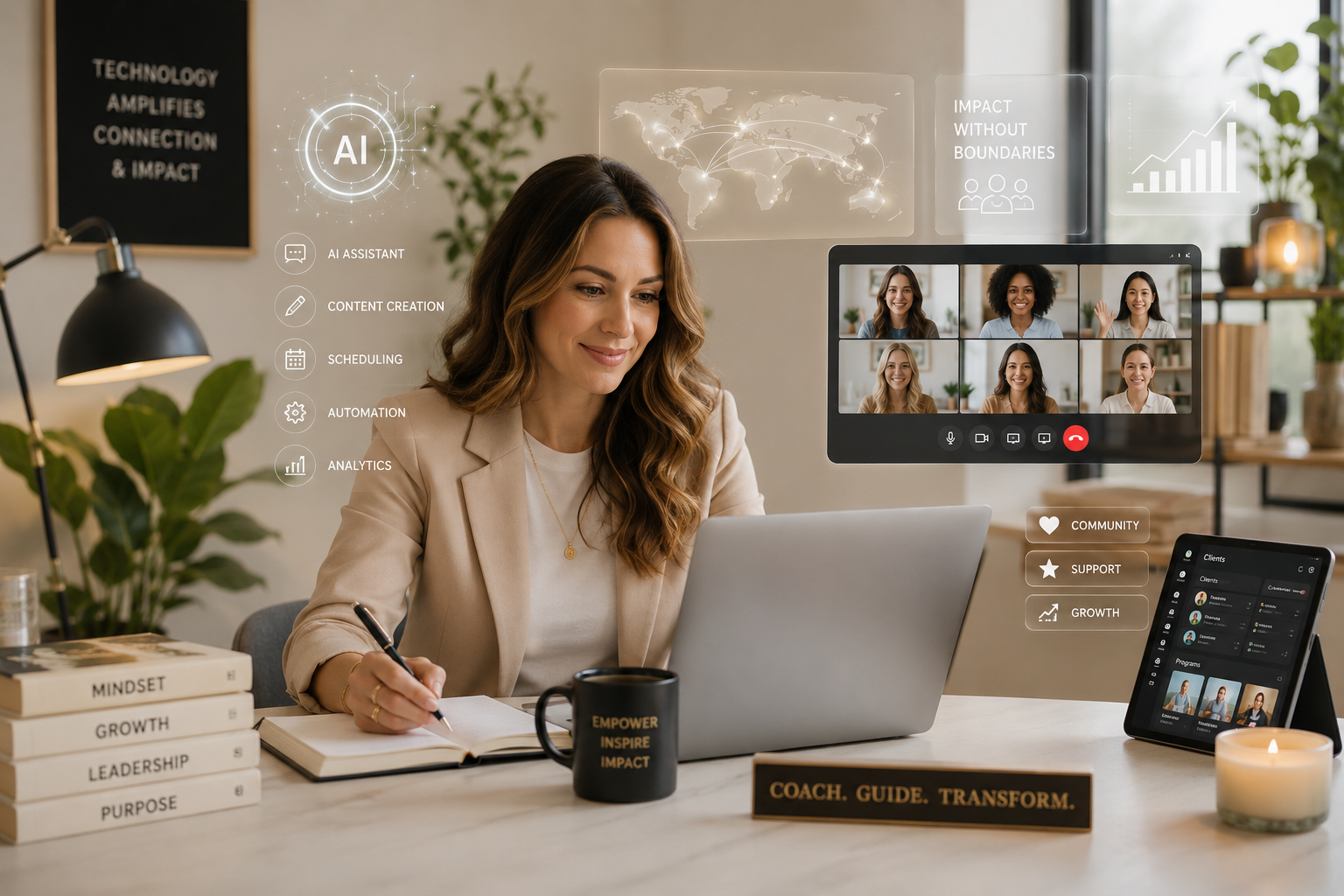
The most successful American women coaches in 2026 are not choosing between technology and human connection. They are using AI tools to carry the administrative weight so they can spend more hours doing what only a human coach can do. Here is how technology in women coaching across the USA is quietly reshaping who gets to be heard, helped, and led.
Why 2026 Became a Turning Point for Women in Coaching
Coaching has grown into one of the fastest-moving professions in the country, and women are firmly at its center. The 2025 ICF Global Coaching Study, built on responses from more than 10,000 practitioners across 127 countries, counted 122,974 coach practitioners worldwide, a 15 percent jump from 2023, with global industry revenue reaching 5.34 billion dollars. Around 72 percent of those practitioners are women, which makes coaching one of the rare high-growth fields led largely by women on both sides of the conversation.
What changed in 2026 is not the demand. It is the willingness to let technology handle the parts of the work that were quietly burning coaches out. The same ICF research found that only about 19 percent of coaches had invested in new technology in the past year, while 27 percent said they planned to in the next one to three years. In other words, a large wave of adoption is arriving now, and the women who move early are the ones defining what a modern practice looks like.
The reason is simple once you have run a practice. Surveys of coaches consistently show that administrative work, not a shortage of clients, is the single biggest limit on how many people a coach can serve. When scheduling, note-taking, invoicing, and follow-up swallow a third of the week, impact has a ceiling. AI is the first thing that has meaningfully raised that ceiling without asking women to work longer hours.
The AI Tools Women Coaches Are Actually Using in 2026
The useful shift this year is away from novelty and toward tools that give hours back. Below are the categories where women coaches are seeing the clearest return, along with the names that keep coming up in practice.
Scheduling that ends the calendar tennis
The back-and-forth of finding a time is the most universally hated task in coaching. Platforms like Calendly and Acuity Scheduling let clients book, reschedule, and pay in a single flow, with automated reminders that cut down no-shows. It is unglamorous, and it is often the first hour a coach reclaims.
Session notes without breaking presence
This is where the honest excitement lives. AI note-takers such as Fathom, Otter.ai, and Granola join or run alongside a session, capture the conversation, and produce a clean summary with action items instead of a raw transcript. Coaches using these tools commonly report cutting documentation time in half and reclaiming three to five hours a week, time that goes straight back to clients rather than paperwork. For a coach who once stayed up finishing notes, that is not a gadget. It is a different quality of life.
A thinking partner for session prep
Many women coaches now use AI assistants like Claude and ChatGPT as a preparation partner. Fed a short summary of a client’s goals and the themes from the last session, these tools can surface targeted questions, a provisional session framework, and relevant research in a few minutes, replacing a long manual review. Used well, the coach still brings the judgment and warmth. The AI simply clears the runway.
All-in-one platforms for the solo practice
For coaches who would rather not stitch five tools together, purpose-built platforms such as Paperbell and Delenta combine scheduling, payments, contracts, client portals, and AI-generated session summaries in one place. Delenta’s built-in assistant, for instance, drafts a summary and suggested next steps after each session, so the running story of a client’s progress is captured without extra effort.
How Leading American Women Coaches Are Scaling Their Impact
Some of the best female executive coaches in the USA have shown that technology and a deeply personal practice are not opposites. They use it to reach further while keeping their signature approach intact.
Alisa Cohn, the executive coach known for guiding founders through the jump from startup to scale-up, has worked with leaders from companies like Venmo, Etsy, and Google, and extends her reach through books, a widely read newsletter, and digital workshops that carry her frameworks well beyond a one-to-one calendar. Whitney Johnson built her S-Curve model of growth into a company, Disruption Advisors, where a network of certified coaches and a digital platform deliver her method to organizations at a scale no single coach could reach alone.
Dr. Tasha Eurich, an organizational psychologist and bestselling author, has turned her research on self-awareness into assessments and online programs that let far more leaders start the work before they ever meet a coach. Sally Helgesen, long regarded as a leading voice on women’s leadership, reaches a global audience through her writing, courses, and speaking, while Cynthia Pong’s firm Embrace Change uses group programs and digital resources to bring executive coaching to women of color who have historically been priced out of it. In each case, the technology is a multiplier. The credibility, the point of view, and the trust are still entirely human.
Digital Coaching Platforms Are Widening the Door for Women
The bigger story is about access. Digital coaching platforms for women are making support available to people who were never going to hire a private executive coach. Enterprise platforms like CoachHub use AI-based matching to pair employees with the right coach from a network of thousands of certified professionals, and they now serve more than a thousand companies including names like Coca-Cola and Virgin Atlantic, putting real coaching within reach of mid-level managers, not just the C-suite.
On the self-guided end, platforms such as Rocky.ai offer daily AI check-ins, goal-setting prompts, and reflective exercises. Their own data suggests people who engage in daily check-ins progress toward goals more than twice as fast as those who check in weekly. No serious voice in the field is claiming this replaces a human coach. What it does is meet people in the gaps between sessions, and reach the many who would otherwise have no coaching at all. For a mission built on lifting women up, that widening door is the part worth cheering.
What Technology Still Cannot Replace
It would be dishonest to write this without the counterweight. The bedrock of coaching, the trust, the presence, the ability to hear what a client is not saying, remains stubbornly human, and every credible practitioner says so. The ICF’s own guidance treats AI as a way to ease the administrative load and sharpen insight, while keeping a certified human at the center of the relationship.
The women coaches getting this right share one habit. They automate the busywork and protect the conversation. AI drafts the notes, but the coach decides what matters. AI surfaces a pattern across six months of sessions, but the coach chooses how and when to name it. The tools that fail are the ones used to fake a human touch, because clients notice generic content instantly. The tools that win are the ones that give a coach more of herself to give.
The Future of Women Coaching in 2026 and Beyond
The future of women coaching in 2026 looks less like robots giving advice and more like human coaches with far more capacity and far better information. Expect hybrid practices to become the norm, blending live sessions with AI-supported check-ins between them. Expect predictive insight, where a coach can see how a client’s energy shifts around a recurring theme long before it would surface from memory alone. And expect the administrative floor to keep dropping, which quietly means coaching can become more affordable and more available to women who were shut out of it.
The throughline is encouraging. Technology in women coaching across the USA is not thinning out the human element. It is removing the friction that kept talented women from reaching more people. The coaches who thrive will be the ones who let the tools carry the load, and pour the reclaimed time back into the work that changes lives.
Are you a woman building a coaching practice, or leaning on a coach to grow? We would love to hear how technology has changed your journey. Share your story with the Humans of Fuzia community and connect with women writing the next chapter of leadership together.
Frequently Asked Questions
What are the best AI tools for women coaches in 2026?
The highest-return tools fall into four buckets: scheduling (Calendly, Acuity), AI session notes (Fathom, Otter.ai, Granola), session prep and pattern-spotting (Claude, ChatGPT), and all-in-one platforms (Paperbell, Delenta). Most coaches start with scheduling and notes, since those reclaim time fastest.
Will AI replace human women coaches?
No. AI handles admin, documentation, and preparation, but the trust, empathy, and presence at the heart of coaching stay human. Industry bodies like the ICF are clear that a certified human belongs at the center of the relationship, with AI as a support, not a substitute.
How do digital coaching platforms for women actually work?
They generally do one of two things. Enterprise platforms like CoachHub use AI to match a person with a certified human coach, while self-guided platforms like Rocky.ai deliver daily prompts and check-ins on their own. Both aim to make coaching reach people who could not access it before.
Who are some of the best female executive coaches in the USA to learn from?
Widely respected names include Alisa Cohn for founders, Whitney Johnson for growth and disruption, Dr. Tasha Eurich for self-awareness, Sally Helgesen for women’s leadership, and Cynthia Pong for women of color navigating their careers. Following their books and talks is an accessible first step.
How much time can AI genuinely save a coaching practice?
It varies, but AI note-taking alone commonly saves three to five hours a week, and coaches who build a fuller stack across scheduling, content, and admin often report reclaiming ten or more. The point is not the hours themselves. It is what a coach chooses to do with them.