



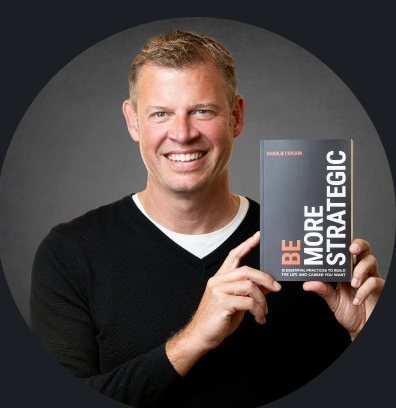
The strategist, coach and author believes strategy is less about producing the perfect plan and more about learning how to make better choices.
Some conversations tell you what someone does. Others reveal how someone thinks.
Our conversation with Charlie Curson began with his career in strategy consulting and the entrepreneurial journey that followed. But as he spoke about strategy, scaling, leadership and the realities of entrepreneurship, we began to see different layers to his thinking – and a common thread running through them all.
For Curson, strategy is not simply something you create. It is something you practise in the way you think, decide, lead and respond to change.
As the conversation developed, four connected ideas emerged – different applications of the same underlying belief about what it really means to be strategic.
That philosophy has developed throughout Curson’s career, from his years in strategy consulting to the practice he established 16 years ago, his work as a coach, strategic advisor and investor and, most recently, his book Be More Strategic.
Strategy Is About Choices, Not Just Plans
Curson spent years working as a strategy consultant before becoming increasingly interested in the gap between what is called strategy and what actually helps a business make better decisions and deliver results consistently.
There was plenty of analysis. Plenty of presentations. And, as he puts it, plenty of “very beautiful and very expensive PowerPoint decks.”
But a detailed analysis does not necessarily tell a business what choices it should make. Nor does a beautiful slide necessarily provide a clear and compelling argument.
That distinction became central to his thinking. Strategy and planning are not the same thing. Planning is about determining what needs to happen. It can create an illusion of control. Strategy is about making choices: where to focus, what direction to take, what to prioritise – and importantly, what not to do. Strategy comes first.
His experience at a smaller, fiercely independent strategy consultancy reinforced that belief. The firm competed successfully against much larger consultancies and, on one occasion, even partnered with McKinsey, with each side bringing different capabilities to the engagement.
Sixteen years ago, Curson took that thinking into his own practice, Mandarin. As his work expanded into coaching, leadership development and advising senior teams, the question became broader. It was no longer simply how to develop a strategy, but how to be more strategic.
For Curson, strategic thinking should not be restricted to CEOs, isolated strategy teams or boardrooms. It is a capability that can influence how people think, communicate, make decisions and respond when circumstances change – at every level of an organisation and even in how they approach their lives outside work.
That thinking eventually became the foundation for the international bestseller Be More Strategic: 12 Essential Practices to Build the Life and Career You Want, which Curson published in 2025.
Don’t Scale What You Haven’t Proven
When the conversation moved from strategy to entrepreneurship, the same thinking appeared in a different form: scaling.
Curson has been involved in multiple businesses and is also an angel investor, giving him exposure to companies at different stages of development. His advice to founders is straightforward: prove the model before you invest heavily in scaling it.
The temptation to scale early is understandable. A company raises money, hires people, enters a new market or launches partnerships, and all of those things can look like progress. But activity is not the same as proof.
Curson believes founders need to be comfortable experimenting in the early stages, investing enough to test an assumption, learning from what happens and being willing to change direction.
One of the biggest traps, he suggests, is falling in love with an idea before it has demonstrated that it works commercially. The strategic discipline, therefore, is not simply about moving faster. It is about knowing what has actually been proven – and what remains an assumption – before deciding what and when to scale.
The same principle applies to entering new markets. A model that works in one market may require adaptation in another because customers, sectors and competitive environments change the assumptions underneath a business. People often underestimate this, which is why international expansion is so fraught with risk, and often fails.
For Curson, expansion requires understanding rather than ambition alone. Sometimes the change required may be relatively small. The challenge is knowing what needs to change and what needs to remain intact.
Strategic Leadership Starts With Self-Awareness
Scaling also raises another question: who do you build around yourself?
Curson sees self-awareness as an important part of strategic leadership. Founders can sometimes recruit people who resemble themselves because it feels natural. But a growing business does not necessarily need more versions of its founder. It needs capabilities, experiences and perspectives that the business – and sometimes the founder – does not have.
So rather than simply asking, “Who should I hire?”, a better question is: “What does the business need that I do not provide?”
Curson’s own operating model reflects that thinking. His core business is a small team supported by associates across the UK and internationally. Those associates come from very different backgrounds, including professional sport, the military, academia, venture capital and media.
Depending on the work, they may operate alongside him or contribute specific expertise to a project. This does more than provide additional capacity. It brings different perspectives into the room.
That same belief sits at the heart of the six-month programme Curson launched following the successful publication of his book – the Strategic Capability Accelerator. The programme brings together scale-up founders, agency leaders, corporate executives and professionals from different sectors and countries.
For Curson, the diversity of the group is not incidental to the learning.
People who would not ordinarily meet are exposed to different ways of looking at the same problem. A founder may see a challenge differently after hearing from a corporate executive; someone from one industry may bring an unexpected perspective to another.
The group itself becomes part of the learning.
The Honest Entrepreneur Knows They Don’t Have All the Answers
Perhaps the most revealing part of our conversation came when we asked Curson what it means to be an honest entrepreneur.
His answer brought the other layers together.
Start by being honest with yourself.
Entrepreneurship is often presented through its most polished stories: the successes, the growth, the milestones and the founders who go on to achieve something remarkable. The less visible part is the uncertainty, the setbacks, the wrong turns and the difficult decisions.
“It is hard,” Curson says. “No matter what stage you’re at, it is a bit of a roller coaster.”
For him, honesty also means being willing to surround yourself with people who can challenge you: peers, mentors, investors, coaches and communities.
Not simply people who encourage you, but people who help keep you honest.
That idea connects back to his broader view of strategy. Strategic thinking requires the ability to question assumptions, recognise blind spots and remain open to perspectives that may challenge your own. It also requires the confidence to admit when you don’t know something and the flexibility to change your mind when the evidence changes. Or technically, make a new decision.
Looking across the conversation, the four layers begin to connect.
The strategy consultant questioning whether what organisations called strategy was really strategic. The advisor encouraging founders to prove a model before scaling it. The leader emphasising self-awareness when building teams. And the entrepreneur acknowledging just how difficult building and growing a business can be.
They are different subjects, but they reveal a remarkably consistent way of thinking.
Curson is not presenting strategy as a formula that guarantees an outcome. He is describing something more demanding: a way of operating.
Question the assumption. Test the model. Know what you know – and what you don’t. Bring in perspectives that challenge your own. Make choices and trade-offs rather than simply adding more activity. And when the evidence changes, be willing to change course.
Because the real test of strategy is rarely when everything goes according to plan. It is what happens when it doesn’t.
That may be the deeper meaning behind Be More Strategic.
It isn’t simply about learning how to build a strategy. It is about developing the capability to think and act more strategically – one decision at a time. .
About Charlie Curson
Charlie Curson is a strategic advisor, accredited leadership and performance coach, author and angel investor. Over more than 25 years, he has worked with leaders, teams and organisations across more than 300 organisations and 30 sectors around the world, from global businesses including Visa, Unilever, McDonald’s, BP, Audi and L’Oreal to mid-sized organisations and fast growing scale-ups.
He is the founder of Mandarin and author of the international bestseller Be More Strategic: 12 Essential Practices to Build the Life and Career You Want, which explores how strategic thinking can be developed as a practical human capability through the choices, decisions and behaviours we make every day.
Connect with Charlie:
Charlie Curson on LinkedIn
Mandarin Associates / Team Mandarin
Be More Strategic – Charlie’s book